


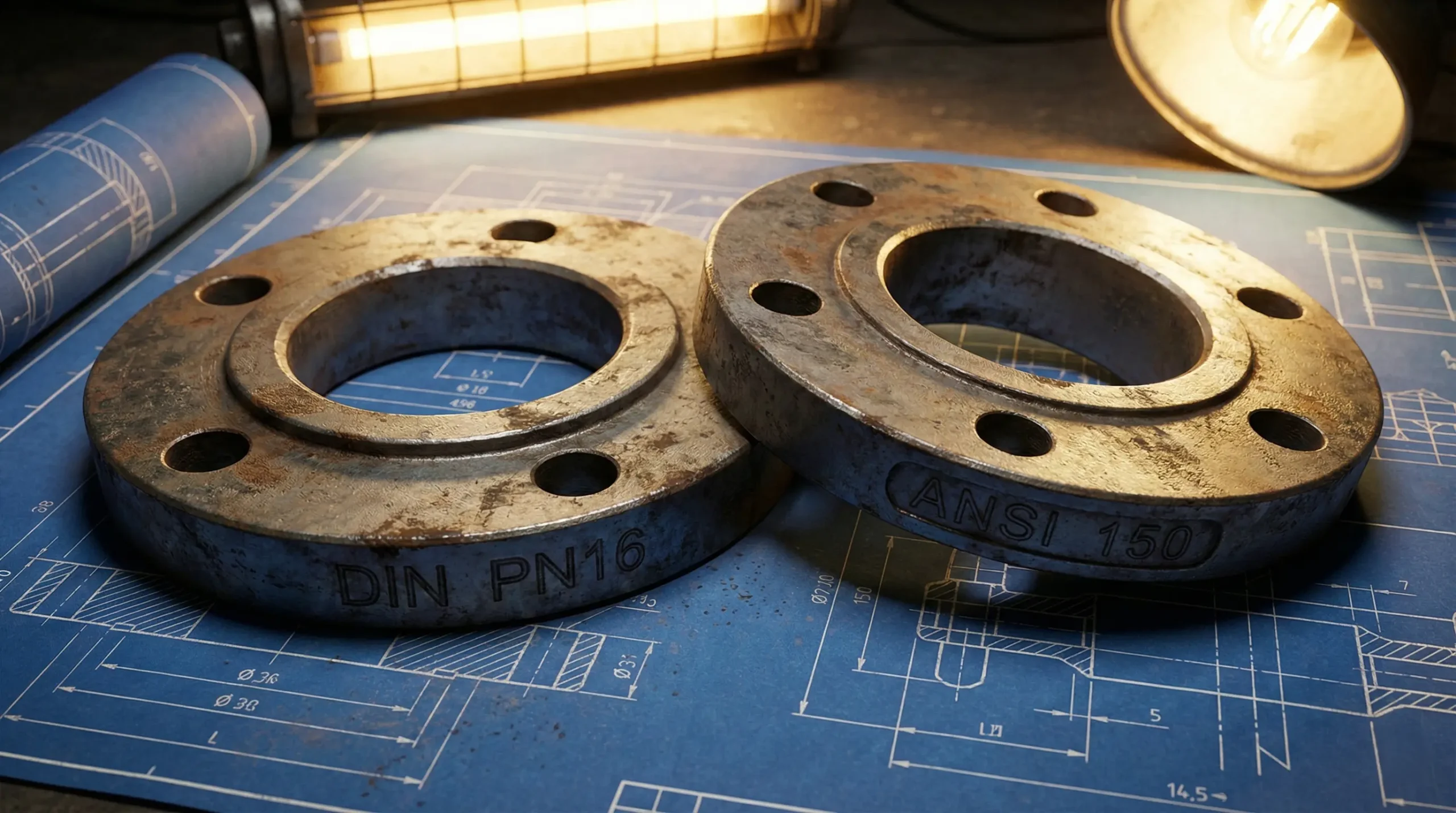
On international projects, mixed specifications are common: piping and fittings under DIN/EN (EN 1092-1) combined with an imported valve supplied with an ANSI flange (ASME B16.5). The issue shows up late: on site, bolt holes don’t align, the bolt circle doesn’t match, and installation stops.
| DN (mm) | Inches | Bolt circle diameter (DIN EN 1092-1 PN10) |
Bolt circle diameter (ANSI/ASME B16.5 Class 150) |
Compatible? |
|---|---|---|---|---|
| DN50 | 2" | 165 mm | 120.7 mm | No |
| DN80 | 3" | 200 mm | 190.5 mm | No |
| DN100 | 4" | 220 mm | 228.6 mm | No |
Engineering note: Bolt circle values (PCD/BCD) depend on pressure rating/class (PN/Class) and the exact standard. DN ↔ inches is nominal guidance; bolt patterns and flange facing are not guaranteed to match.
Why “forcing” assembly is not a solution
When bolt circles don’t match, forced installation typically results in angled bolts, misalignment, or uneven gasket compression. The common outcome is loss of tightness (micro-leaks on pressurization), premature gasket damage, and rework.
Field-ready option: Universal Flange Adaptors
To connect equipment across standards without welding or machining, a standard engineering approach is the use of Universal Flange Adaptors. They compensate for differences in bolt patterns and flange geometries between DIN and ANSI while keeping gasket compression controlled and installation repeatable.
At FM Pipefitting, we supply Universal Flange Adaptors for typical site scenarios: integrating ANSI valves into DIN networks, substitutions due to regional availability, and mixed-standard tie-ins in EPC projects. Selection should be based on pipe OD range, pressure/class, and the flange standard on each side.
Pre-purchase checklist (DIN vs ANSI)
- Confirm the exact standard: EN 1092-1 (DIN/EN) vs ASME B16.5 (ANSI).
- Confirm pressure/class: PN10/PN16/PN25 vs Class 150 (and design temperature).
- Check bolt pattern: number of holes, hole diameter, and bolt circle diameter (PCD/BCD).
- Check flange facing: RF/FF/RTJ and compatible gasket type.
- Verify bolt length: flange thickness + gasket + washers/nuts.
Engineering recommendation
For new networks, keep one flange family per line section (DIN or ANSI) and define it clearly in the procurement specification. When imported equipment or substitutions are unavoidable, a universal adaptor reduces site downtime and lowers the risk of leaks caused by off-standard assembly.
Frequently asked questions (FAQ)
Are DN and inches equivalent?
They are nominal equivalents. They help sizing, but do not guarantee bolt pattern or flange face compatibility.
Can we elongate holes to fit the bolts?
Not recommended: it reduces effective section, affects washer/nut bearing, and introduces unintended stresses. In service, it increases the risk of leakage and loosening.
What data is needed to specify an adaptor?
DN/OD (actual pipe outside diameter), standard and PN/Class on each side, facing type (FF/RF), and service/application.
Technical summary
- Standards covered: ISO 2531, EN 545, ASME B16.5
- Pressure rating: PN10 / PN16 / PN25 / Class 150
- Stock: Immediate dispatch to LATAM and Europe